



Knowledge Base
Everything you need to know about Pressure Regulators: Types, Selection, and Installation.
A Complete Guide to Understanding and Choosing Pressure Regulators
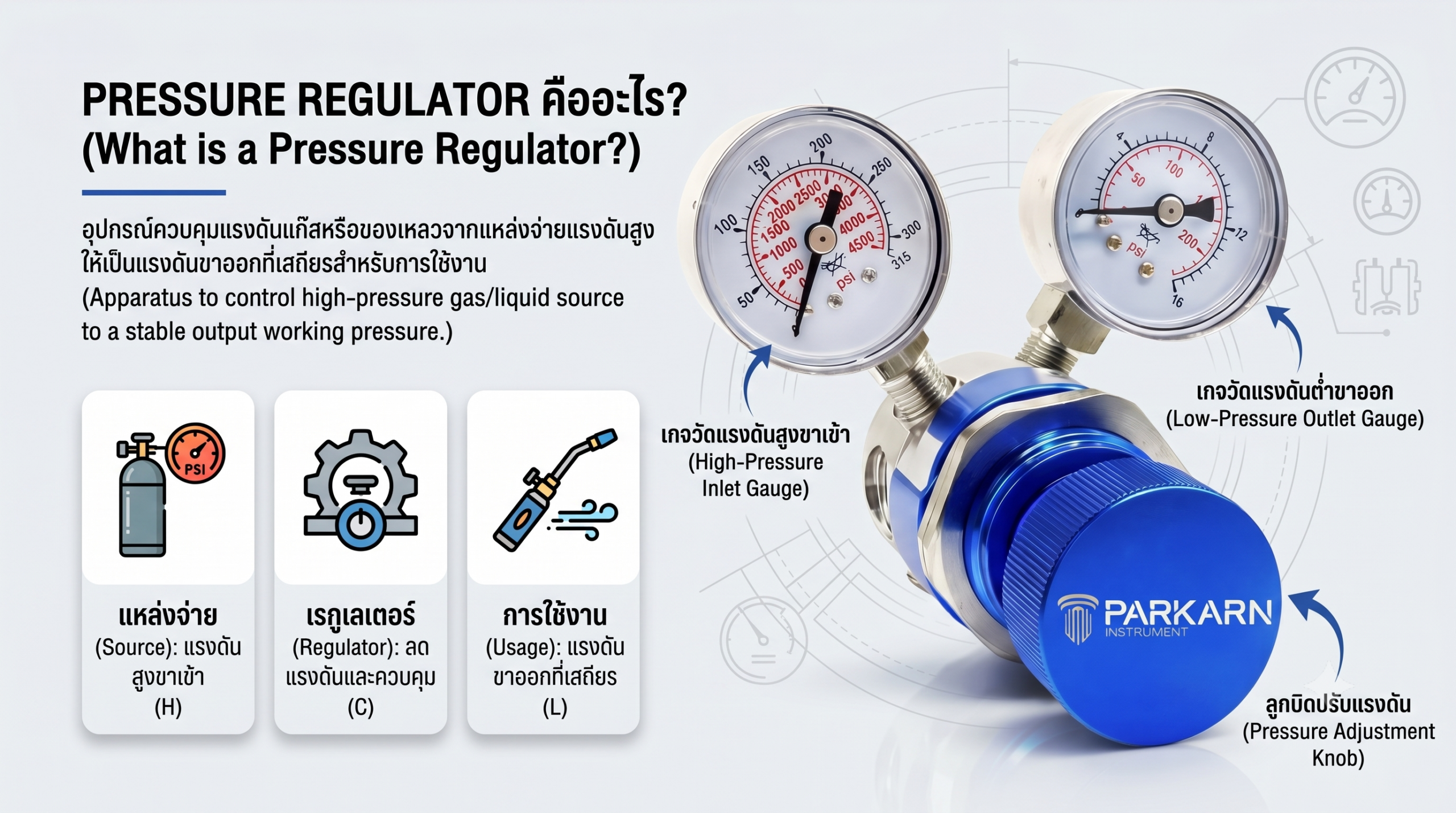
Many people wonder, what exactly is a pressure regulator? In the engineering and industrial world, it is the “pressure guardian” responsible for taking high pressure from a source (like a gas cylinder or pump) and reducing it to a lower, constant, and safe pressure for downstream applications.
Imagine if this device wasn’t there to act as a barrier—massive pressure could surge directly into your million-dollar analytical instruments or completely destroy your factory’s piping system. Today, the engineering team at Vows Craft will take you on a deep dive, from its internal structure and how to select the right one, to the correct installation procedures.
1. Engineering Principles of a Pressure Regulator
To truly understand what a pressure regulator is, we must look at its internal structure. The main mechanism is driven by the coordination of 3 key components:
- Spring: Provides the downward force to set the desired outlet pressure.
- Diaphragm: A flexible element that senses changes in outlet pressure and moves to maintain balance.
- Valve Seat: The part that opens and closes to control the volume of fluid passing into the system.
Pressure Reduction Mechanism
Its operation is based on maintaining a Force Balance, which can be explained through the relationship between Inlet Pressure and Outlet Pressure as shown in this equation:
When you use the equipment, the downstream pressure (Poutlet) drops, reducing the upward force against the spring. The spring then overcomes this force, pushing the valve wider open so more fluid flows in until the pressure balances out again.
Single-stage vs Dual-stage Regulators: What’s the difference?
Reduces pressure from the cylinder to the application in “one step”. Ideal for general applications where a slight outlet pressure variation (supply pressure effect) as the cylinder empties is acceptable.
Works like two regulators in series. It reduces pressure in two stages, keeping the outlet pressure extremely stable and precise. Perfect for analytical lab work requiring high stability.
2. Types of Pressure Regulators
Due to diverse industrial needs, regulators are categorized by application, body material, and pressure range as follows:
By Application
- Gas Regulator: Designed specifically for gases. Available for both general industrial and High Purity gas applications.
- Liquid Regulator: Designed for liquids. Features a robust mechanism to withstand hydraulic shocks and prevent cavitation.
- Back Pressure Regulator: Operates in reverse. Instead of controlling downstream pressure, it “maintains upstream pressure,” preventing it from dropping below a set point.
By Body Material
- Brass: Cost-effective. Ideal for air or general inert gases (e.g., N2, Ar, He).
- Stainless Steel (SS 316L): Excellent corrosion resistance. Suitable for harsh chemicals, toxic gases, or Food Grade applications.
- Plastic (PTFE, PVC): Used for highly corrosive chemical systems where metals cannot be utilized.
By Pressure Range
Broadly divided into Low Pressure (millibars to a few bars), Medium Pressure (general production lines), and High Pressure (handles cylinder pressures above 200-300 bar).
3. 5 Key Criteria: How to Choose the Right Pressure Regulator
Once you understand what a pressure regulator is, selecting the right one is equally important. Here is a 5-point checklist recommended by Vows Craft.
- Media Type: Ensure whether it is for Gas, Liquid, or Corrosive media to choose the correct type.
- Inlet and Outlet Pressure: You must know the maximum upstream pressure and the desired control range downstream.
- Flow Rate and Cv value: Flow rate is critical. If the Cv (Flow Coefficient) is too small, you will experience a severe pressure drop when the equipment starts.
- Material and Seal Compatibility: O-rings and seals must be compatible with the media. Choose appropriately between Viton, EPDM, or PTFE.
- Environment and IP Rating: If installing outdoors or in a hazardous area, select a model rugged enough for those environmental conditions.
4. Proper Installation and Precautions
Improper installation can have consequences more severe than you might think. Let’s look at the safe procedures.
- Check the Flow Direction: Always look for the arrow on the body. The flow direction must always point toward the destination (Outlet).
- Line Purging: Blow out all debris, pipe shavings, or Teflon tape before assembly. Even a tiny speck can prevent the valve seat from closing fully, causing an immediate leak.
- Always Install a Filter: It is highly recommended to have an in-line filter upstream of the regulator to catch contaminants.
- Unwind the Spring Before Opening the Valve: Crucial Warning! Before opening the gas supply valve, always turn the knob fully counter-clockwise (to relieve spring tension). This prevents a sudden pressure surge from rupturing the diaphragm.
- Leak Testing: After installation, use soapy water or a liquid leak detector (like Snoop) to check every connection point.
5. Common Problems and Troubleshooting
After some time in operation, you might encounter these issues. The table below will help you diagnose and resolve them basically.
| Symptom | Possible Cause | Solution |
|---|---|---|
| Creep (Pressure rise) When downstream flow is stopped, the outlet pressure gauge slowly creeps upwards. |
Dirt or debris is stuck on the valve seat, or the seat has worn out over time. | Disassemble and clean the unit, or purchase a Repair Kit to replace the valve seat. |
| Cannot reduce pressure at all Upon opening, the outlet pressure instantly matches the inlet pressure. |
Ruptured diaphragm, broken spring, or severe internal damage. | Stop using immediately! Send to an expert for repair or replace the unit entirely. |
| Droop (Severe pressure drop) Pressure is set correctly, but drops significantly when equipment is turned on. |
Physical limitation of the regulator, or the selected size (Cv) is too small for the system’s flow demand. | Upgrade to a larger regulator (High Flow model) or switch to a Dome-loaded mechanism. |
6. FAQ — Frequently Asked Questions
A: Standard valves (like Ball Valves or Needle Valves) are used to adjust “flow volume” and turn the system on/off. A Pressure Regulator is used to automatically maintain a constant “pressure,” even if the upstream pressure or flow rate fluctuates.
A: It is not recommended. Gases are compressible, whereas liquids are incompressible. Using a gas regulator for liquids can cause Water Hammer and severely damage the equipment.
A: The first gauge (high-pressure side) indicates the remaining pressure in the cylinder or supply line. The second gauge (low-pressure side) indicates the working pressure you have set to supply your system.
A: It depends on the environment and the media used. For standard inert gases, it can last 5-10 years. However, engineering best practices recommend inspecting and replacing rubber components (overhauling) every 2-5 years.
