





Deep Dive
Understand 4-20mA, HART, Fieldbus, and Wireless Signals in One Complete Guide
A Complete Guide to Transmitter Signals: 4-20mA, HART, Fieldbus & Wireless
What is a Transmitter? Types & Overview
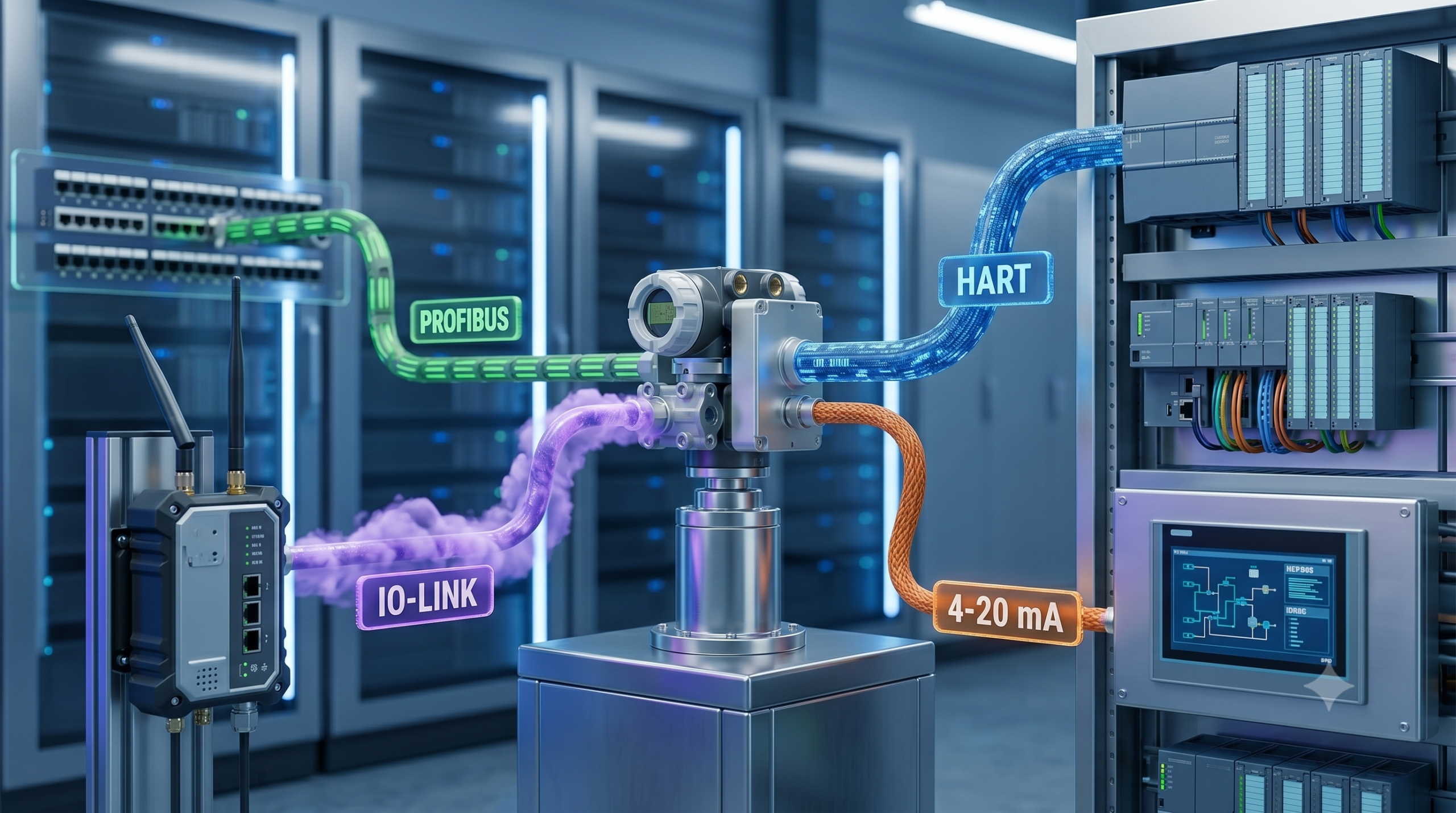
A Transmitter is a device that converts physical values (such as pressure, temperature, or flow rate) into standard electrical signals that a PLC, DCS, or SCADA system can receive. Regardless of what the Transmitter measures, the output signal is always in the same standard format. Because of this, engineers do not have to learn a new interface every time they change measurement types — that is exactly what this article will explain.
Types of Transmitters Common in Instrumentation
| Transmitter Type | What It Measures | Common Sensing Element | Typical Signal Output |
|---|---|---|---|
| Pressure Transmitter | Pressure (Gauge, Absolute, Differential) | Piezoresistive, Capacitive | 4-20mA, HART |
| Temperature Transmitter | Temperature | RTD (PT100/PT1000), Thermocouple (K, J, T) | 4-20mA, HART |
| Flow Transmitter | Flow Rate | DP Orifice, Magnetic, Vortex, Coriolis, Ultrasonic | 4-20mA, Pulse, HART, Fieldbus |
| Level Transmitter | Liquid Level in Tanks | DP, Radar (Guided/Free), Ultrasonic, Capacitance | 4-20mA, HART, Fieldbus |
| Differential Pressure Transmitter | Pressure difference between 2 points | Capacitive Cell, Piezoresistive | 4-20mA, HART, Fieldbus |
Notice that all types use 4-20mA as the primary Signal Output. That’s no coincidence. This standard was cleverly designed to support the widest possible range of applications. In the next section, we will explain why this standard has dominated the market for decades.
4-20mA Analog: The Universal Standard
The 4-20mA signal is a standard that uses electrical current (not voltage) to transmit data, where 4mA represents 0% and 20mA represents 100% of the measurement range. The brilliance of this standard lies in using current instead of voltage. Because current in a series circuit remains constant at every point regardless of cable length, the signal does not degrade over distance—completely unlike a Voltage Signal.
Why 4mA and not 0mA?
This is a very clever Fail-safe Design. If 0-20mA were used, a broken wire would result in 0mA, which looks exactly like a “true zero” reading, leaving the system unable to distinguish between a zero value and a fault. However, by using 4mA as a Live Zero, if the current drops to 0mA or 3.6mA, the system immediately knows the wire is broken or the transmitter has a problem. Furthermore, the 4mA base current can be used as a Power Supply for 2-Wire transmitters.
Voltage drop across the 250Ω Load Resistor:
At 4mA >> V = 0.004 × 250 = 1.0V (0% of Range)
At 12mA >> V = 0.012 × 250 = 3.0V (50% of Range)
At 20mA >> V = 0.020 × 250 = 5.0V (100% of Range)
Conversion Formula: PV = [(I – 4) ÷ 16] × (URV – LRV) + LRV
Example: I = 12mA, Range 0-100°C >> [(12-4)/16] × 100 = 50°C
- Simple and easy to wire
- Highly resistant to electrical noise
- Long-distance transmission (No Voltage Drop effect)
- Inexpensive and widely used
- Supported by all PLCs
- Transmits only 1 value at a time
- No built-in diagnostics
- Cannot be remotely configured
- Requires individual wiring for every device
HART Protocol: Digital over Analog
The HART Protocol is a technology that superimposes a digital signal over standard 4-20mA wiring using Frequency Shift Keying (FSK). It assigns 1,200 Hz to represent “1” and 2,200 Hz to represent “0”. Because this digital signal has a much higher frequency than the analog signal, filter circuits can completely separate them without any interference.
Diagnostics: Read device status, internal temperature, operating hours, Error Codes.
Secondary Variable: Read additional values, e.g., Process Fluid Temperature alongside Pressure.
Trim / Calibration: Perform Zero Trim and Span Trim remotely without walking to the field.
Device Information: Read Serial Number, Firmware Version, Manufacturer ID.
- No additional wiring needed; uses existing 4-20mA wires
- Includes Diagnostics and Remote Config
- Can transmit Secondary Variables
- Widely supported by all major vendors
- Slow communication speed (~2-3 messages/sec)
- Requires 230-500Ω Loop Resistance
- Still requires individual wiring for every device
- Requires a HART Modem/Communicator
Fieldbus: High-Speed Pure Digital
Fieldbus is a purely digital communication standard, completely eliminating the 4-20mA analog signal. All data is transmitted as digital packets on a single cable connecting multiple devices simultaneously. This capability allows engineers to drastically save on wiring compared to running individual 4-20mA lines. Currently, there are 3 main standards found in the Process Industry.
PROFIBUS PA (Process Automation) uses a single twisted-pair cable to deliver both data and power to multiple field devices simultaneously on the same bus. Furthermore, it operates at a speed of 31.25 kbps and is designed to support use in hazardous areas (Intrinsic Safety).
- Connects multiple devices on one cable, saving wire
- Comprehensive Diagnostics
- Supports Intrinsic Safety
- Integrates well with SIMATIC PLCs
- Requires additional DP/PA Couplers
- Slower speed than PROFINET
- Higher installation cost than 4-20mA
Foundation Fieldbus stands out because it can process Control Functions directly inside the Field Device (e.g., PID Loops) without sending data back to the Controller every time. As a result, the system has high reliability and faster response times than other standards. It offers two levels: H1 (31.25 kbps for Process) and HSE (High Speed Ethernet) for applications requiring higher speeds.
- Processes Control logic in the field
- High interoperability across brands
- Popular in Safety-critical Applications
- Complex to commission
- Higher device cost than PROFIBUS
- Requires specialized experts
PROFINET and EtherNet/IP use standard Ethernet infrastructure but are designed for Real-time Industrial Control with high speeds of 100 Mbps and above. In terms of flexibility, both standards support various topologies and integrate directly with Cloud and IIoT systems, rapidly making them the primary standards in Smart Factories and Industry 4.0.
- Very high speed (>100 Mbps)
- Uses standard Ethernet infrastructure
- Supports IIoT and Industry 4.0
- Flexible Topologies
- Requires Industrial Grade Switches
- More complex than PROFIBUS for Process
- Higher infrastructure cost
IO-Link: Modern, Low-Cost Digital
IO-Link is a Point-to-Point Digital Communication standard between an IO-Link Master and Sensors/Actuators, using standard 3-wire unshielded cables. It communicates at speeds ranging from 4.8 kbps to 230.4 kbps. Because all data is transmitted digitally, it is more accurate than 4-20mA analog (no calibration drift) and can send multiple values simultaneously over a single cable.
- Low cost, uses standard cables
- No analog calibration drift
- Remote Config and Diagnostics
- Can transmit multiple values simultaneously
- Auto-restores parameters when replacing devices
- Maximum cable length is 20 meters
- Requires an IO-Link Master
- Not yet fully suitable for all Process Industry applications
Wireless: No Cables Required
WirelessHART (IEC 62591) and ISA100.11a are two popular wireless standards in the Process Industry. Both operate on the 2.4 GHz frequency as a Mesh Network. With a mesh structure, each device can relay signals for others, significantly increasing coverage and network reliability.
- No wiring needed, lowers installation cost
- Easy to install in difficult/high locations
- Mesh Network increases reliability
- Can upgrade existing wired HART devices
- Slow Update Rate (~1-60 seconds)
- Battery management is required
- Increased security considerations
- Not suitable for Control Loops
Signal Comparison Table
| Signal | Type | Speed | Diagnostics | Remote Config | Cost | Best Suited For |
|---|---|---|---|---|---|---|
| 4-20mA | Analog | ● Medium | ● None | ● No | ● Low | General use, All PLCs |
| HART | Analog + Digital | ● Medium | ● Yes | ● Yes | ● Medium | Plants requiring Remote access |
| PROFIBUS PA | Digital Fieldbus | ● Fast | ● Yes | ● Yes | ● High | Large plants, Siemens systems |
| Foundation Fieldbus | Digital Fieldbus | ● Fast | ● Yes | ● Yes | ● High | Oil & Gas, Petrochemical |
| PROFINET / EtherNet/IP | Industrial Ethernet | ● Very Fast | ● Yes | ● Yes | ● High | Smart Factories, Industry 4.0 |
| IO-Link | Point-to-Point Digital | ● Fast | ● Yes | ● Yes | ● Low | General Factory Automation |
| WirelessHART | Wireless | ● Slow | ● Yes | ● Yes | ● Medium | Remote / Hard-to-install areas |
How to Choose the Right Signal
-
1Do you already have a PLC/DCS? What signal type does it support?Older PLCs with 4-20mA AI Cards >> Use 4-20mA or HART immediately without extra investment. | New PLCs supporting Fieldbus >> Consider PROFIBUS or PROFINET based on your vendor.
-
2Do you need Diagnostics and Remote Config?No >> 4-20mA is sufficient and most economical. | Yes, but don’t want new wiring >> HART is the answer. | Yes, and willing to invest in a new system >> Fieldbus or IO-Link.
-
3How many devices are there and what is the installation distance?Few devices, short distance >> 4-20mA or IO-Link. | Many devices on a single Bus >> PROFIBUS PA or Foundation Fieldbus. | Remote, hard to wire >> WirelessHART.
-
4Is the application Process Control or Factory Automation?Process Control (Chemical, Oil, Pharma) >> HART, PROFIBUS PA, Foundation Fieldbus. | Factory Automation (Assembly, Discrete) >> IO-Link, PROFINET, EtherNet/IP.
- Small plant, limited budget >> 4-20mA all the way. Simple and most economical.
- Plants with good Maintenance systems >> HART for all devices to instantly add Predictive Maintenance.
- New plants using Siemens >> PROFIBUS PA or PROFINET from the start.
- Oil & Gas / Petrochemical >> Foundation Fieldbus is the industry standard.
- Smart Factory / Industry 4.0 >> IO-Link + PROFINET is the answer.
- Retrofitting difficult spots, tall tanks, remote areas >> WirelessHART saves massively on installation.
Frequently Asked Questions (FAQ)
Tell us about your PLC system and requirements, and we’ll help design the perfect solution.
