






How-to Guide
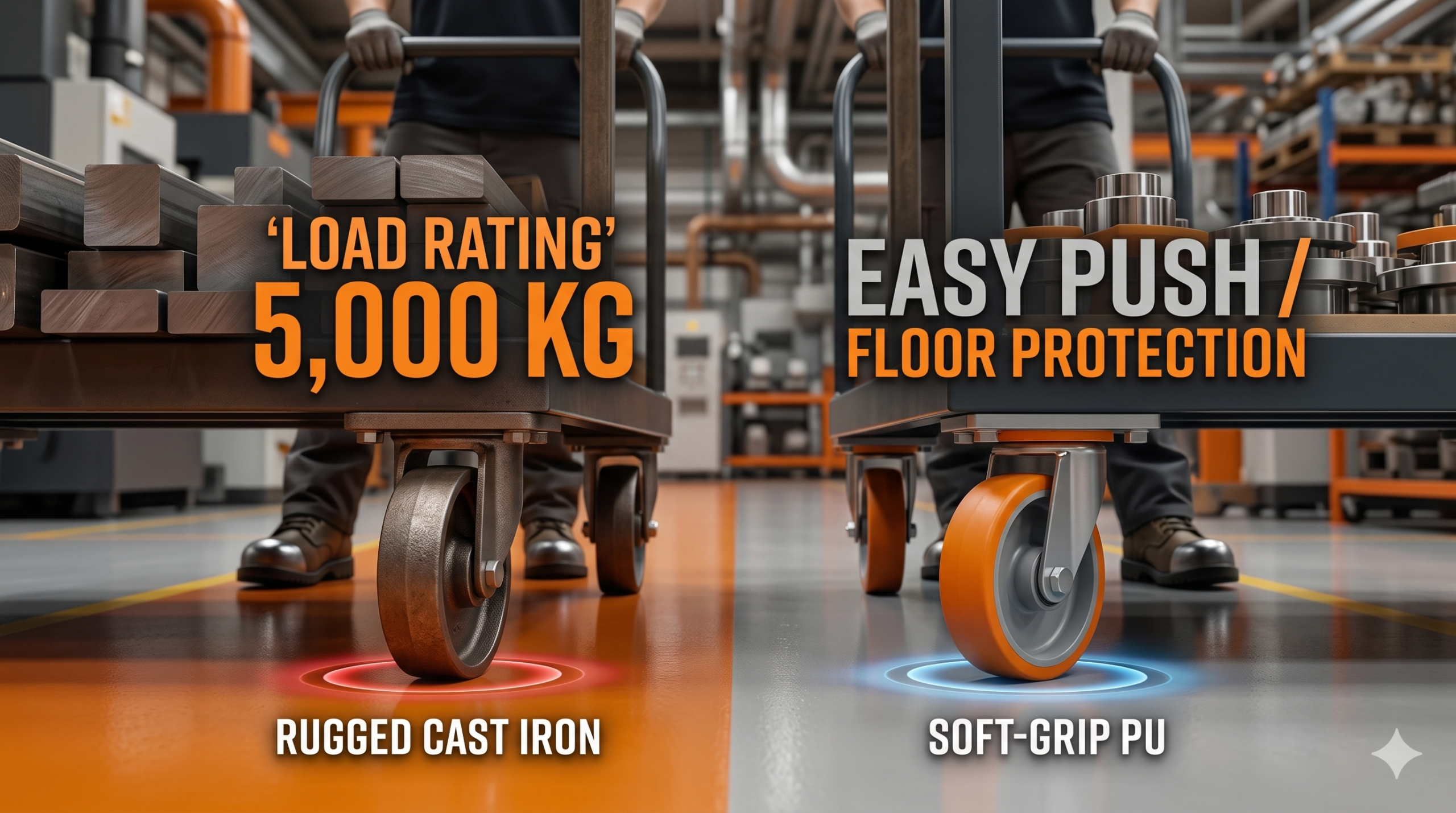
How to Choose Industrial Casters for Precise Load Rating and Floor Protection
A Complete Guide to Industrial Caster Selection
What Are Industrial Casters?
Industrial Caster Wheels are mounted beneath machinery, control cabinets, racks, or factory carts to allow easy movement without lifting. Beyond the convenience of mobility, correctly specified casters also absorb shocks that could damage machinery, protect factory floors, and reduce the risk of employee injury.
However, industrial casters aren’t a one-size-fits-all product. Different types are engineered for specific weights, surfaces, and environments. Making the wrong choice can lead to consequences far more severe than you might expect.
Types of Industrial Casters
Industrial casters are generally divided into two main categories based on mobility, with several sub-types depending on the application.
By Rotation
By Mounting Style
- Plate Mount: Mounted via 4 bolts through a base plate. Suitable for flat machinery bases and evenly distributed loads.
- Stem Mount: Mounted using a cylindrical stem. Ideal for furniture and small-to-medium equipment.
- Bolt Hole Mount: Mounted through a single central bolt hole. Great for high-strength applications where mounting space is limited.
Wheel Materials: Match Your Floor and Environment
Wheel material impacts load capacity, rolling noise, and floor protection. Since materials vary significantly in their properties, choosing the right one for your operating conditions is critical.
Wheel Material Quick Reference Table
| Material | Load Rating | Temp Resistance | Chem Resistance | Noise Level | Floor Protection |
|---|---|---|---|---|---|
| Polyurethane | ● High | ● Medium (~80°C) | ● Medium | ● Quiet | ● Excellent |
| Rubber | ● Medium | ● Low (~60°C) | ● Low | ● Very Quiet | ● Excellent |
| Nylon | ● Very High | ● High (~120°C) | ● Good | ● Loud | ● Moderate |
| Stainless Steel | ● High | ● Very High | ● Excellent | ● Loud | ● Moderate |
| Cast Iron | ● Highest | ● Extreme (>200°C) | ● Medium | ● Very Loud | ● Poor |
Calculating the Correct Load Rating
This is where many people make a critical mistake. Choosing casters simply based on the equipment’s static weight—without considering the Safety Factor or actual operating conditions—often leads to overloaded wheels and premature failure.
Step 2: Divide by the number of casters. (e.g., for 4 casters >> Load per caster = Total Load ÷ 4)
Step 3: Multiply by the Safety Factor based on usage conditions:
Smooth floors, slow movement >> × 1.3
Uneven floors, occasional impact >> × 1.5 – 2.0
High-speed or frequent movement >> × 2.0 – 3.0
Example: An 800 kg machine uses 4 casters on an uneven floor.
Load per caster = (800 ÷ 4) × 1.5 = 200 × 1.5 = 300 kg/caster
Therefore, you should choose a caster with a Dynamic Load Rating of ≥ 300 kg each.
How to Select the Right Caster for the Job
Once you know the required Load Rating, the next step is to consider other factors that impact long-term performance.
-
1What is the floor surface?Smooth, Epoxy, or Tile >> PU or Rubber for floor protection. | Rough concrete >> Nylon or Cast Iron for better load handling. | Metal surfaces or rails >> Cast Iron or Steel.
-
2What is the operating environment?Oil or Chemicals present >> Nylon or SS. | High heat (Ovens, Foundries) >> Cast Iron or High-Temp Nylon. | Cleanrooms / Food / Pharma >> SS 316 only.
-
3Do you need locks or brakes?Machine must be stationary during use >> Choose Swivel with Total Lock Brake. | Moves in straight lines only and doesn’t need locking >> Rigid/Fixed casters are more economical and stronger.
-
4Frequency and speed of movement?Frequent movement over long distances >> Choose a larger wheel diameter (larger wheels = less rolling resistance). | Rarely moved >> Standard sizes are sufficient.
-
5Mounting type on the machine base?Flat base underneath >> Plate Mount is the strongest. | Holes for cylindrical stems >> Stem Mount. | Central screw hole >> Bolt Hole Mount.
- Calculated the Dynamic Load Rating per caster, including a Safety Factor.
- Specified a wheel material suitable for the floor and environment.
- Selected Swivel or Fixed types based on mobility needs.
- Determined if standard Brakes or Total Locks are required.
- Verified the mounting type and dimensions fit the machine base.
- Added a 20-30% load buffer for uneven load distribution.
Common Problems and Solutions
| Problem | Cause | Solution |
|---|---|---|
| Wheels flattening or breaking prematurely | Load Rating is too low, or no Safety Factor was applied. | Recalculate the load using a 1.5–2.0 Safety Factor and upgrade to a higher-rated caster. |
| Hard to push / stiff movement | Bearings are dirty/unlubricated, or wheel diameter is too small for the load. | Clean and lubricate bearings. | Upgrade to a larger wheel diameter to reduce rolling resistance. |
| Floor is getting scratched or damaged | Wheels are too hard (Nylon/Cast Iron) for coated floors, or severely overloaded. | Switch to Polyurethane (PU) or Rubber wheels. | Distribute the load by adding more casters. |
| Swivel doesn’t rotate or is stiff | Swivel bearings are dirty or rusted, especially in wet environments. | Clean and lubricate the swivel race regularly. | Use sealed bearings in wet or washdown areas. |
| Brakes won’t hold the equipment | Brake mechanism is worn, or the load exceeds the brake’s holding capacity. | Switch to a “Total Lock” brake that locks both the wheel and swivel. | Ensure the brake load rating is sufficient. |
Frequently Asked Questions (FAQ)
Tell us your load requirements, floor type, and environment, and we’ll help you find the exact match.
