



How-to Guide
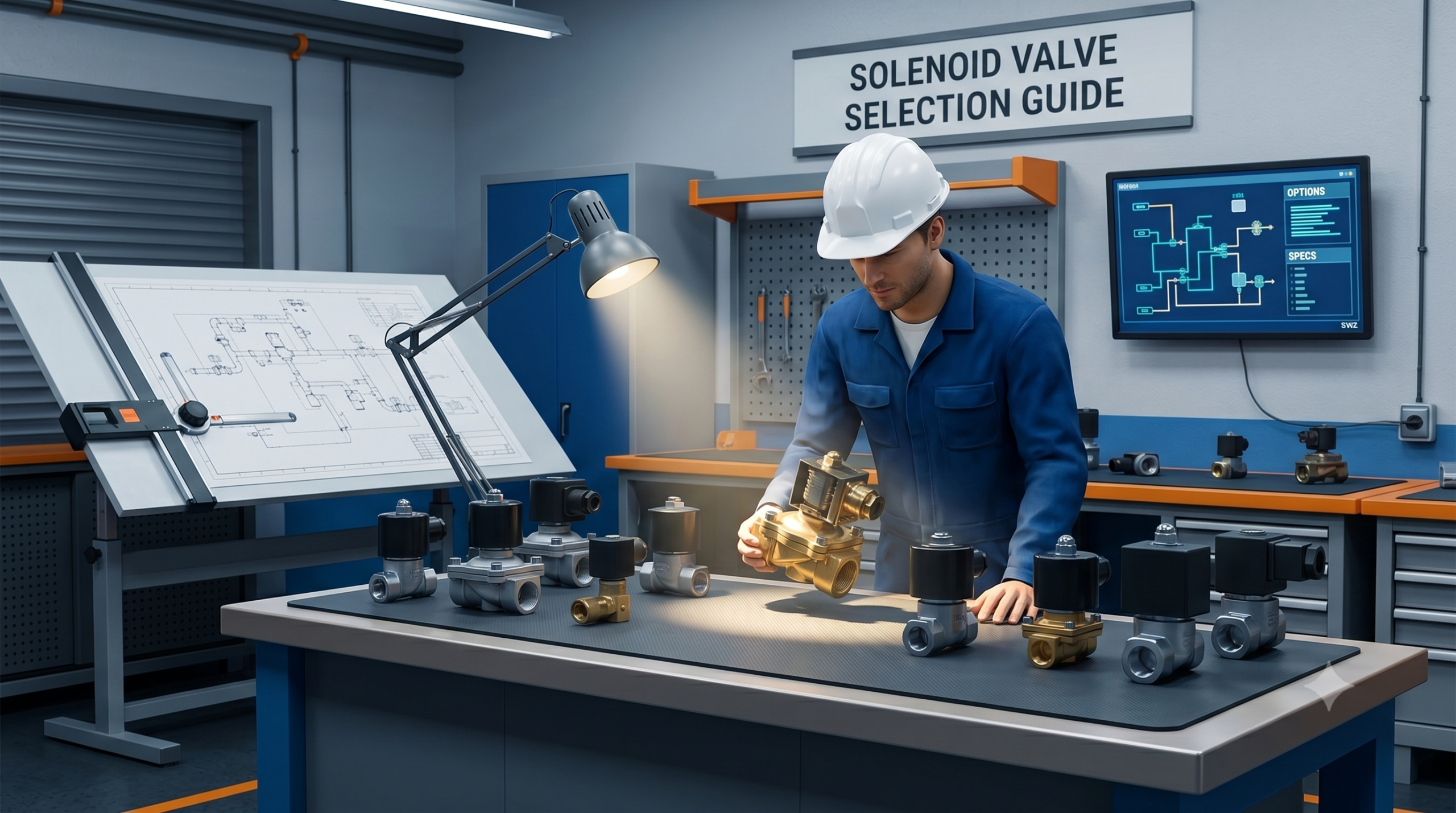
The Complete Solenoid Valve Selection Guide: Covering Every Factor from Fluid Type to IP Rating
Complete Solenoid Valve Selection Guide: From Fluid Type to IP Rating
- Why is Solenoid Valve Selection Important?
- Factor 1: Type of Fluid (Media)
- Factor 2: Body and Seal Materials
- Factor 3: Operating Pressure
- Factor 4: Flow Rate and Cv Value
- Factor 5: Voltage and Duty Cycle
- Factor 6: IP Rating and Environment
- Summary Table: Media >> Suitable Materials
- Frequently Asked Questions (FAQ)
Why is Solenoid Valve Selection Important?
With hundreds of Solenoid Valve models from various manufacturers, even minor differences in materials, pressure, and seals can lead to completely different outcomes. This article compiles every factor you need to consider, complete with a quick-reference summary table.
Factor 1: Type of Fluid (Media)
This is the first and most critical factor, as the type of media dictates everything from the body material to the compatible seal type.
- Water: Standard Brass + NBR Seal works fine. For Drinking Water, select Food-grade SS 316 + EPDM.
- Oil/Petroleum: Brass + NBR or FKM (Viton) Seals provide excellent oil resistance.
- Air/Inert Gas: Standard Brass with NBR Seals is sufficient.
- Steam: Requires an SS Body + PTFE Seal and a High-temp Coil exclusively.
- Concentrated Acids/Bases: PVC or PP Body + PTFE Seals. Avoid all metals.
- Food & Beverage / Pharma: SS 316L + EPDM or PTFE Seals meeting FDA/3A standards.
- Flammable Gases (LPG, NG): Must use models with Explosion-proof and Gas-approved certifications.
Factor 2: Body and Seal Materials
Body Material
| Material | Key Features | Limitations | Best For |
|---|---|---|---|
| Brass | Economical, durable, widely available | Poor acid/base resistance, not for food | Water, oil, air, inert gases |
| SS 304 | Good corrosion resistance, clean | Less chloride resistance than SS 316 | Clean applications, general food |
| SS 316L | Highest corrosion resistance among SS | Higher cost than SS 304 | Pharma, chemicals, marine environments |
| PVC | Excellent acid/base resistance, low cost | Low heat tolerance, limited pressure | Strong acids/bases, water treatment |
| PP (Polypropylene) | Broader chemical resistance than PVC | Low heat tolerance | Highly corrosive chemicals |
Seal Material (O-ring)
| Seal Material | Temp Range | Best For | Avoid |
|---|---|---|---|
| NBR (Nitrile) | -30 to +100°C | Oil, water, air, general use | Ozone, Ketones, Aromatics |
| EPDM | -50 to +150°C | Hot water, low-pressure steam, weak acids/bases, food | Oils, Petroleum |
| FKM (Viton) | -20 to +200°C | Oils, chemicals, high temperatures | Ketones, Amines, Low-temps |
| PTFE | -200 to +260°C | Almost all chemicals, steam | Inflexible, requires structural support |
| FFKM (Kalrez) | -20 to +320°C | Extremely harsh chemicals, semiconductor manufacturing | Very high cost |
Factor 3: Operating Pressure
You must specify both the Minimum Operating Pressure (MOP) and Maximum Operating Pressure before selecting.
-
1Check Minimum Operating PressurePilot Operated Valves require a minimum differential pressure (e.g., 0.5 bar). If your system has low pressure or operates in a vacuum, you must choose Direct Acting valves.
-
2Check Maximum Working PressureSelect a valve with a Pressure Rating at least 20% higher than your system’s maximum pressure for a safe margin.
-
3Beware of Pressure Surges (Water Hammer)Systems with fast-closing valves can experience severe pressure spikes. You must choose a higher Pressure Rating or use a slow-closing valve.
Factor 4: Flow Rate and Cv Value
The Cv Value (Flow Coefficient) indicates how many gallons of water per minute (GPM) can pass through the valve at a 1 psi pressure drop. A higher Cv means higher flow capacity.
Q = Flow Rate (GPM) / SG = Specific Gravity (Water = 1.0) / ΔP = Pressure Drop (psi)
Example: Need 10 GPM flow at ΔP = 25 psi >> Cv = 10 × √(1/25) = 10 × 0.2 = 2.0
Choose a valve with a Cv ≥ 2.0.
Factor 5: Voltage and Duty Cycle
- AC 220V 50Hz: Used in standard residential and industrial power systems in Thailand (and many other regions).
- DC 24V: Ideal for direct connection to PLCs or controllers. Faster response time than AC.
- AC 110V / DC 12V: Used in specialized systems. Ensure specifications match your power supply.
- Continuous Duty Coil: Can be energized 24/7. Perfect for valves that stay open for long periods.
- Intermittent Duty Coil: Can only be energized 20-50% of the time. Cheaper, but beware of overheating if left on too long.
Factor 6: IP Rating and Environment
| IP Rating | Protection Level | Best For |
|---|---|---|
| IP54 | Partial dust protection, splash proof | Indoors, slight humidity |
| IP65 | Dust tight, water jet proof | Outdoors, washdown areas |
| IP67 | Dust tight, temporary immersion | Wet areas, frequent washdowns |
| IP68 | Continuous immersion | Underwater, irrigation |
| ATEX / Ex-proof | Explosion protection in hazardous areas | Flammable gas/vapor environments |
Summary Table: Media >> Suitable Materials
| Media Type | Body | Seal | Notes |
|---|---|---|---|
| Standard Water | Brass | NBR / EPDM | Use EPDM for hot water |
| Drinking Water / Food | SS 316L | EPDM / PTFE | Must be FDA/3A compliant |
| Air / N₂ / Ar | Brass | NBR | Ready for general use |
| Hydraulic Oil | Brass / SS | FKM (Viton) | Check pressure rating |
| Steam | SS 304/316 | PTFE | Requires high-temp coil |
| Diluted Acids | PVC / SS 316 | PTFE / FKM | Check chemical compatibility |
| Strong Bases (NaOH) | PVC / PP | EPDM / PTFE | Avoid Brass and Aluminum |
| Flammable Gases (LPG/NG) | Brass / SS | NBR / FKM | Requires Gas-approved cert |
| Pharmaceutical | SS 316L | PTFE / Kalrez | Must meet USP Class VI |
| Seawater / Chlorinated | SS 316L / Titanium | FKM / PTFE | SS 304 is not chloride-resistant |
- Identify media type and properties (acid/base/flammable/temp).
- Identify the system’s Min and Max pressure.
- Calculate required Cv Value from your flow rate.
- Specify the required Voltage and Duty Cycle.
- Specify IP Rating based on the installation environment.
- Check required certifications like FDA, ATEX, or Gas-approved.
Frequently Asked Questions (FAQ)
and we’ll help you find the exact match on the first try.
