




Problem-Solution
5 Warning Signs Your Pneumatic System Is Failing — Diagnose Before It Stops the Line
Learn to spot the symptoms early and fix them right on the factory floor.
- Pneumatic Systems Don’t Fail Overnight
- Signal 1: Cylinder Not Extending Fully or Moving Slowly
- Signal 2: Compressor Runs Constantly or Cycles Frequently
- Signal 3: Water or Oil Discharging with Air
- Signal 4: Constant Hissing Sounds
- Signal 5: Solenoid Valve Acting Inconsistently
- Troubleshooting Checklist Table
- Easy Preventive Maintenance for Technicians
- Frequently Asked Questions (FAQ)
Pneumatic Systems Don’t Fail Overnight
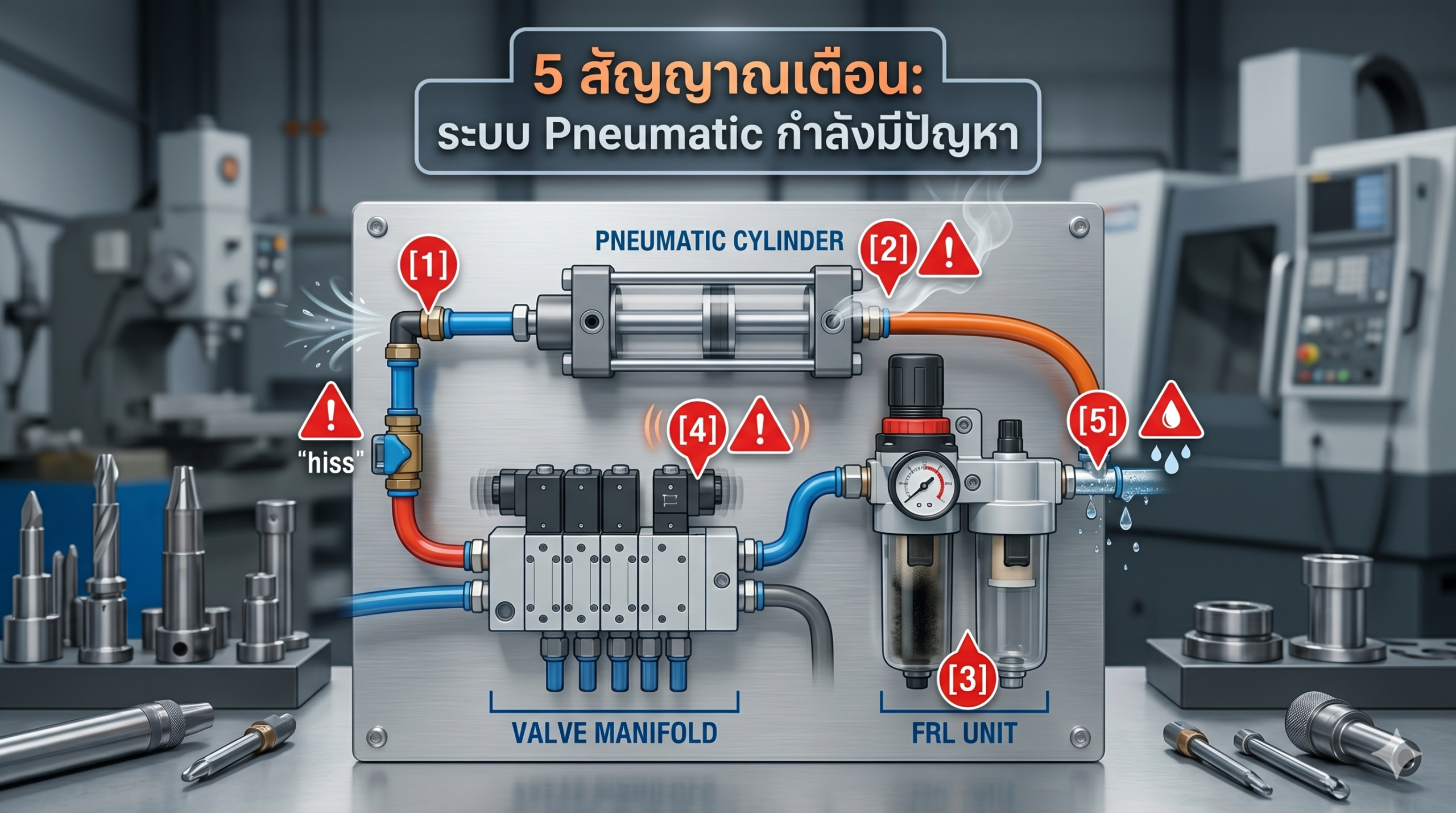
Pneumatic systems usually send warning signs long before they completely shut down. However, these symptoms develop so gradually that factory personnel often get used to them and overlook them. This article compiles the 5 most common warning signs, along with practical troubleshooting steps you can perform without special tools.
Cylinder Not Extending Fully or Moving Slowly
This is the most common warning sign and usually the first one noticed, as it directly impacts product quality and production cycle times.
- Cylinder moves halfway and stops, even after receiving a signal from the PLC.
- Extends fully but with diminishing force, eventually lacking the power for the task.
- Cycle times become longer without an obvious cause, though the machine still runs.
- Works fine in the morning but slows down in the afternoon (often happens when factory temperatures rise).
- System pressure drops below cylinder requirements >> Check the pressure gauge at the FRL first.
- Speed Controller (Flow Restrictor) is too tight >> Try loosening it slightly and observe.
- Solenoid Valve is partially blocked >> Exhaust air will feel unusually weak.
- Cylinder seals are degraded >> Air leaks past the piston to the opposite side.
If the exhaust is very weak >> Not enough air is reaching the cylinder >> Check system pressure and the valve.
If exhaust is strong but the cylinder is slow >> It’s a mechanical issue (e.g., overload or cylinder binding).
Step 2: Measure pressure directly at the cylinder inlet port.
If pressure is sufficient but it still won’t push >> Degraded seals or load exceeds the cylinder’s rating.
Compressor Runs Constantly or Cycles Frequently
This sign is often ignored because the compressor is still supplying air. In reality, it means your system is losing compressed air faster than it can produce it.
- A compressor that used to rest for 5-10 minutes per cycle now runs continuously.
- Factory electricity bills spike without a corresponding increase in production.
- The compressor runs hotter than usual, shortening its lifespan.
- Accumulated air leaks >> The compressor is constantly compensating.
- Increased system demand >> e.g., Adding new machines without upgrading compressor capacity.
- Faulty Pressure Switch >> Fails to cut the circuit when target pressure is reached.
- Worn Unloading Valve or Check Valve on the compressor.
If it drops <0.1 bar in 5 min >> System is normal.
If it drops >0.5 bar in 5 min >> Significant leak present; a full system leak survey is required.
Water or Oil Discharging with Air
This is the most dangerous sign in terms of being overlooked. The damage isn’t immediate, but it compounds over time, eventually destroying expensive equipment.
- Water droplets visible at the exhaust ports of solenoid valves or cylinders.
- Solenoid valves failing frequently with no obvious cause.
- Cylinders rusting internally or seals wearing out much faster than expected.
- Filter bowls are constantly full of water.
- Filter bowl is full, auto-drain is broken, or manual draining was forgotten.
- No After-Cooler or Air Dryer installed >> Moisture enters the system directly.
- Summer or high humidity seasons >> Water volume in the air is naturally higher.
- Lubricator set too high >> Excess oil builds up inside the valves.
Long term: Install a Refrigerated Air Dryer downstream of the after-cooler to remove moisture before it enters the system.
Constant Hissing Sounds
A sound factory workers get so used to they tune it out—but it represents money leaking away every second.
- Hearing a faint hiss around fittings, tubes, or valve bodies constantly.
- System pressure runs slightly below the setpoint chronically.
- The hissing gets louder after the machine has been running (fittings expand with heat).
Since the Pressure Ratio (P_atm/P_sys) = 1/8 = 0.125 is lower than the Critical Pressure Ratio (~0.528), Choked Flow occurs. Air velocity at the leak ≈ speed of sound (340 m/s).
Leak cross-sectional area A = π/4 × (0.001)² = 7.85 × 10⁻⁷ m²
Flow rate Q = A × v = 7.85 × 10⁻⁷ × 340 ≈ 2.67 × 10⁻⁴ m³/s
Power Loss (Isothermal):
W = P × Q × ln(P_sys/P_atm) = 800,000 × 2.67 × 10⁻⁴ × ln(8) ≈ ~0.44 kW
Electricity Cost (assuming 4 THB/kWh, 8,000 hours/year):
0.44 kW × 8,000 h × 4 THB = ~14,000 THB/year per single leak
If a factory has 10 such leaks (which is very common) >> ~140,000 THB/year wasted.
The pro way: Use an Ultrasonic Leak Detector. It can pinpoint leaks from a distance even while the machine is running, ideal for large facilities.
Solenoid Valve Acting Inconsistently or Erroring
When this happens, people usually blame the PLC or wiring first. But the root cause is often the compressed air itself, not electricity.
- PLC sends a signal, but the cylinder doesn’t move—even when coil voltage is verified.
- The valve fires sporadically with no predictable pattern.
- Replacing the valve fixes it temporarily, but the new one fails soon after.
- Coils get unusually hot or burn out repeatedly.
Most valves have an override button for testing without electricity.
If overriding moves the cylinder >> The problem is electrical or the PLC signal.
If overriding does NOT move the cylinder >> The problem is pneumatic (low pressure, blocked valve).
Step 2: Check pressure directly at the Valve Inlet
If it’s below the valve’s Minimum Operating Pressure >> You lack air pressure, the valve itself isn’t broken.
- Pilot-Operated valves require a minimum differential pressure to shift >> They won’t open if pressure drops too low.
- Water or dirt (from Signal 3) clogs the tiny pilot orifice inside the valve.
- Incorrect coil voltage, or voltage drops caused by excessively long cable runs.
Troubleshooting Checklist Table
Use this quick-reference guide when issues arise on the floor.
| Symptom | Check This First | Common Causes | Initial Fix |
|---|---|---|---|
| Cylinder won’t extend fully | Pressure gauge at FRL | Low pressure, Speed controller tight, Worn seals | Check pressure >> Loosen speed controller >> Inspect seals |
| Compressor runs constantly | Close isolation valve, time pressure drop | Accumulated leaks, Demand exceeds capacity | Conduct full plant leak survey |
| Water in the air lines | Filter bowl and Auto-drain | No air dryer, Broken auto-drain | Drain daily >> Install Air Dryer |
| Chronic hissing sound | Apply soapy water to fittings | Loose fittings, Degraded O-rings | Tighten joints >> Replace seals >> Leak survey |
| Inconsistent Solenoid Valve | Press Manual Override | Pressure below Min OP, Clogged valve, Electrical issue | Override test >> Check air pressure >> Test coil voltage |
Easy Preventive Maintenance for Technicians
Routine preventive maintenance dramatically reduces the chances of encountering these 5 warning signs. Here is a recommended frequency schedule.
- Drain water from filter bowls every shift (if no auto-drain is present).
- Listen for abnormal hissing or knocking sounds in the system.
- Verify FRL pressure gauges are within the required operating range.
- Check lubricators to ensure adequate oil levels and proper drop rate (via sight glass).
- Test auto-drains by manually triggering them.
- Verify the operation of cylinder rod locks or brakes (if equipped).
- Perform a soapy water leak survey on critical systems and log findings.
- Check filter elements (Replace if pressure drop exceeds 0.5 bar).
- Top up oil levels in lubricator bowls.
- Inspect cylinder rods and piston rods for scoring, scratches, or rust.
- Compare regulator inlet and outlet pressures against standard setpoints.
Frequently Asked Questions (FAQ)
Tell us the symptoms, and we’ll help you diagnose the root cause with precision.
