Comparison
What is the Difference Between Mass Flow and Volumetric Flow? How to Choose the Right One for Your Application
Key Differences, Physics Principles & How to Choose the Right Measurement
By Vows Craft Team
September 2026
8 min read
Last updated: September 2026
Definitions and Units
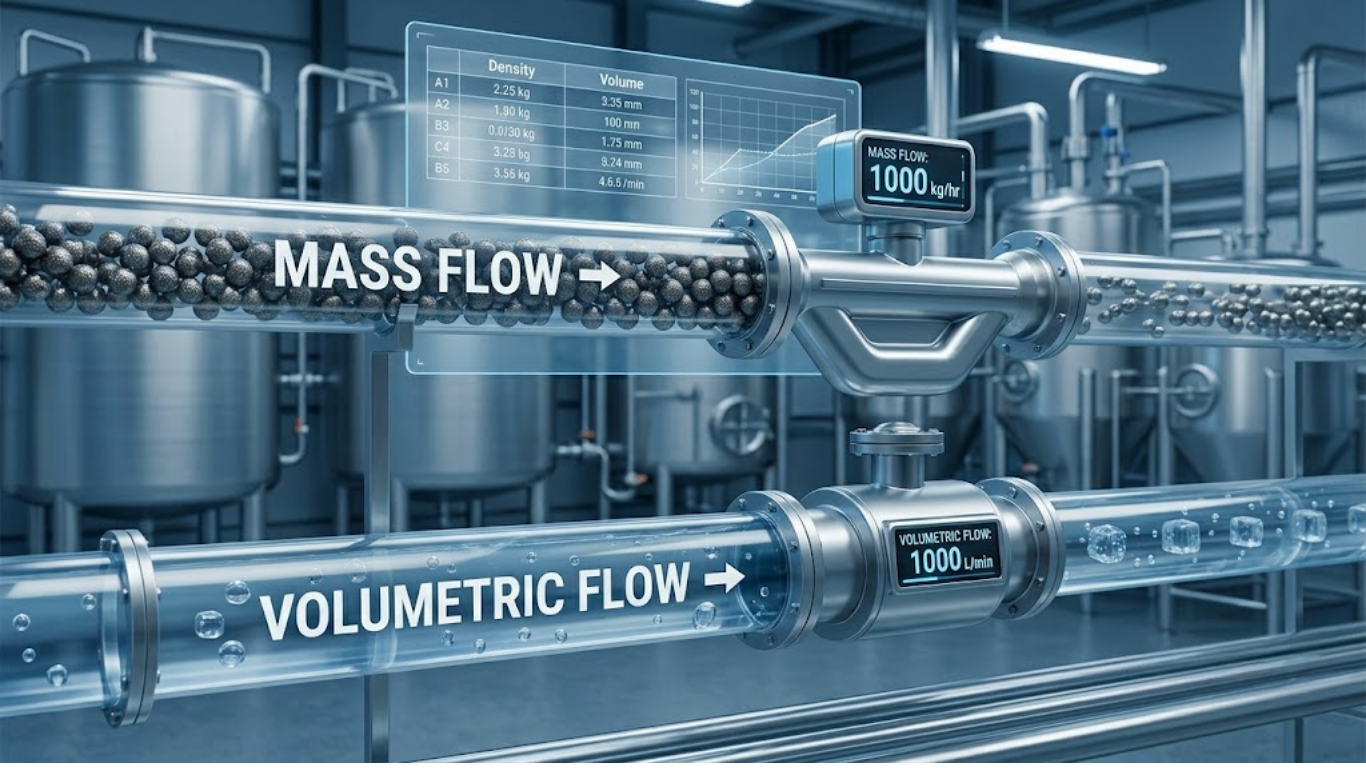
Volumetric Flow Rate measures volume per unit time and varies with temperature and pressure | Mass Flow Rate measures mass per unit time and remains constant regardless of process conditions.
Volumetric Flow Rate measures volume per unit time and varies with temperature and pressure | Mass Flow Rate measures mass per unit time and remains constant regardless of process conditions.
Volumetric Flow Rate
Measures the volume of a substance flowing per unit of time
Fundamentally, gas volume depends on the current temperature and pressure according to the Ideal Gas Law (PV = nRT). Therefore, measured values change with conditions even if the actual number of molecules remains the same.
Mass Flow Rate
Measures the mass of a substance flowing per unit of time
Conversely, mass remains constant according to the law of conservation of mass. It does not change with temperature or pressure, making values directly comparable across all conditions and perfectly aligned with chemical reaction stoichiometry.
| Feature |
Volumetric Flow |
Mass Flow |
| What it Measures |
Volume per time |
Mass per time |
| Common Units (Gas) |
L/min, m³/hr, CFM |
g/s, kg/hr, SCCM, SLM |
| Common Units (Liquid) |
L/min, GPM, m³/hr |
kg/hr, g/min |
| Changes with Temp |
● Yes (Gas) |
● No change |
| Changes with Pressure |
● Yes (Gas) |
● No change |
| Best For |
Liquids, gases at constant temp and pressure |
Gases, applications with fluctuating temp and pressure |
Physics Principles: Why Volumetric Flow Changes with Temperature and Pressure
Essentially, the principle explaining the difference between Volumetric Flow and Mass Flow lies in the Ideal Gas Law. This law explicitly defines the relationship between pressure, volume, number of moles, and temperature of a gas.
Ideal Gas Law
PV = nRT
P = Pressure (Pa) | V = Volume (m³) | n = Number of moles | R = Gas constant (8.314 J/mol·K) | T = Absolute temperature (K)
Rearranged: V = nRT / P
Specifically, this means when n (number of moles) is constant:
When temperature increases >> V increases (gas expands)
When pressure increases >> V decreases (gas is compressed)
Therefore, Volumetric Flow Rate = ṁ × RT / (M × P)
Where ṁ = Mass Flow Rate and M = Molar mass of the gas
Effects of Temperature and Pressure on Volumetric Flow
From the equation Volumetric Flow Rate = ṁ × RT / (M × P), it can be clearly seen that Volumetric Flow Rate is directly proportional to absolute temperature (T). Simultaneously, it is inversely proportional to pressure (P), while Mass Flow Rate (ṁ) remains strictly constant.
In other words, when temperature increases at a constant pressure, the gas naturally expands. Consequently, this causes the Volumetric Flow Rate to increase proportionally to the absolute temperature, even though the actual number of molecules flowing per unit time remains completely unchanged. On the other hand, when pressure increases at a constant temperature, the gas compresses into a smaller volume. As a result, the Volumetric Flow Rate decreases proportionally to the pressure.
For instance, consider N₂ at a Volumetric Flow Rate of 10 L/min at 20°C and 1 bar. If the temperature increases to 100°C at the same pressure, the Volumetric Flow Rate will immediately increase to 10 × (373/293) = 12.73 L/min. Thus, there is an increase of about 27% simply because of the temperature change. Meanwhile, the Mass Flow Rate remains exactly the same, which is the main reason why Process Control applications with temperature or pressure variations must use Mass Flow instead.
Significance for Process Control
Furthermore, in manufacturing processes where temperatures change between upstream and downstream (e.g., before and after a Heat Exchanger), significant errors can occur. If you measure Volumetric Flow at one point and apply it to another, the calculated values will immediately be incorrect relative to the Absolute Temperature. Ultimately, this can directly impact process balance and final product quality.
Direct Comparison: Pros and Cons
Pros and Cons of Volumetric Flow
Pros
- Easy to measure, cheaper equipment
- Highly suitable for incompressible liquids
- Provides easy installation and maintenance
- Sufficient for constant temp and pressure applications
Cons
- Values fluctuate significantly with temp and pressure
- Requires constant compensation for accuracy
- Generally not suitable for varying gas conditions
- Does not naturally align with chemical stoichiometry
Pros and Cons of Mass Flow
Pros
- Maintains constant values regardless of environmental shifts
- Aligns perfectly with chemical stoichiometry
- Ideal for critical Combustion and Gas Mixing tasks
- Establishes a uniform standard across all conditions
Cons
- Involves more expensive measurement equipment
- Is structurally more complex, requiring regular calibration
- Thermal MFCs specifically require known gas types
- Must be carefully protected from system moisture
When Volumetric Flow is Sufficient
Generally, Volumetric Flow is sufficient for applications with constant temperature and pressure. Additionally, it is perfect when using incompressible liquids, thereby eliminating the need to invest in more complex and expensive Mass Flow equipment.
Ideal Scenarios for Volumetric Measurement
Incompressible Liquids
Water and general liquids in Cooling or Process systems
Because liquids like water barely expand or contract with pressure, Volumetric Flow directly correlates with the mass flowing. This holds true as long as temperature changes aren’t drastic enough to significantly alter liquid density (e.g., staying within a 10°C difference).
Constant Temperature & Pressure Systems
Gases in strictly controlled temperature and pressure systems
Similarly, if the system can accurately maintain constant temperature and pressure at all times, Volumetric Flow correlates directly with Mass Flow via a constant density. For example, this applies perfectly to a lab strictly controlled at 25°C and 1 bar.
General Monitoring
Flow monitoring for Alarms or Trending
Moreover, for applications aiming to merely verify if flow is occurring or within normal ranges without requiring high precision, Volumetric Flow Meters remain highly cost-effective and perfectly sufficient.
When Mass Flow is Required
Critical Applications for Mass Flow
Chemical Reactions and Stoichiometry
CVD, Combustion, Chemical Synthesis
Fundamentally, chemical reactions depend heavily on the number of reactant molecules, not just volume. Since Mass Flow is directly proportional to the number of moles, it stands as the only correct choice for applications requiring precise reactant ratios.
Multi-Gas Blending
Gas Blending, Specialty Gas Mixtures
Furthermore, blending gases in precise molar ratios always requires Mass Flow because different gases inherently have different densities. Consequently, equal volumetric flow proportions will absolutely not result in equal molar proportions if the gases have different molar masses.
Custody Transfer
Commercial Gas Transactions, Legally Binding Measurements
In addition, commercial gas transactions must be strictly measured by Mass or Standard Volume referencing clear standard conditions. Otherwise, measuring Actual Volume at varying temperatures will yield different values depending on weather conditions, potentially leading to financial disputes.
High Pressure / High Temperature Processes
Systems with significant temperature or pressure variations throughout the process
Finally, consider Hydrogenation processes operating at 50-200 bar or complex systems with inline Heat Exchangers. Measuring Volumetric Flow before and after the exchanger will invariably yield drastically different values despite the actual Mass Flow being identical.
Standard Conditions: A Common Source of Confusion
Crucially, Standard Flow units like SCCM and SLM refer exclusively to predetermined Standard Conditions. However, different international standards define different reference temperatures and pressures, causing calculated flow values to differ even when the actual mass is identical.
The Impact of Standard Conditions
ISO 13443
0°C
1.01325 bar
International standard, highly popular in Europe and the Natural Gas industry
NIST / SEMI
20°C
1.01325 bar
Widely popular in the Semiconductor Industry and most US-made MFCs
DIN 1343
0°C
1.01325 bar
Strict German standard, primarily used in German-origin industries
Errors from using different Standards
As an illustration, if one MFC is calibrated at 0°C (ISO) and another at 20°C (NIST), the displayed flow values will differ by (293/273) – 1 = ~7.3%. This occurs even if the actual mass flowing remains completely identical. Therefore, when ordering an MFC or reading specs, always clarify immediately which Standard Condition is being applied.
Formula for converting between Standard Conditions
Flow (Standard 2) = Flow (Standard 1) × (T_std2 / T_std1) × (P_std1 / P_std2)
Example: Convert 100 SCCM (ISO, 0°C, 1 atm) >> SCCM (NIST, 20°C, 1 atm)
Thus, Flow (NIST) = 100 × (293.15 / 273.15) × (1 / 1) = 107.3 SCCM (NIST)
Summary Table: Scenarios >> Which to Choose
Quick Reference Guide
| Scenario |
Recommendation |
Reason |
| Cooling System Water Flow |
● Volumetric |
Incompressible liquid, constant temp/pressure, complexity not needed |
| CVD Gas Ratio Control |
● Mass Flow |
Reaction depends on molecules, reaction chamber temperature is extremely high |
| Gas Flow before a Furnace |
● Mass Flow |
Gas expands greatly entering the furnace, making volumetric flow unreliable |
| Coolant Oil Flow Monitoring |
● Volumetric |
Liquid, only requires flow status alarms |
| Natural Gas Trading |
● Mass Flow |
Custody Transfer requires Standard units independent of weather conditions |
| Precise Multi-Gas Blending |
● Mass Flow |
Different gases have different densities; mass ensures correct molar ratios |
| Factory Compressed Air Flow (Constant temp/pressure) |
● Either |
If constant, Volumetric is sufficient. For Energy Audits, Mass is more accurate. |
| Combustion Efficiency Monitoring |
● Mass Flow |
Proper Fuel/Air ratios must be based on moles, not volume |
Frequently Asked Questions (FAQ)
Can water be measured with Volumetric Flow, or is Mass Flow required?
Typically, for water at normal temperatures (20–60°C), Volumetric Flow is perfectly adequate for most applications. This is because water acts as an incompressible fluid, meaning its density changes minimally within that range. However, if the water temperature exceeds 80°C, the density change becomes significant. In such cases, Mass Flow or density compensation should certainly be considered.
Should factory Compressed Air use Mass or Volumetric Flow?
Primarily, it depends entirely on the operational objective. For instance, if you just need to monitor whether flow is present, Volumetric is usually sufficient. Conversely, if you want to perform a detailed Energy Audit, calculate compressed air production costs, or accurately detect leak losses, Mass Flow provides far more accurate values. Ultimately, this is because compressed air is at high pressure and consequently has a much higher density than normal air.
What is the difference between Standard Flow and Actual Flow?
Basically, Actual Flow (or Actual Volumetric Flow) represents the true measured volume at the current temperature and pressure conditions present in the pipe. Meanwhile, Standard Flow is that same value mathematically converted back to a fixed reference standard condition (e.g., 0°C, 1 atm) to allow fair comparisons across different states. Consequently, in advanced flow measurement, Standard Flow is commonly reported because it communicates the mass equivalent clearly.
If I only have Volumetric Flow, can I calculate Mass Flow?
Certainly, you can do this by using a standard conversion formula: Mass Flow = Volumetric Flow × Density of the substance at that exact state. Nevertheless, you must know the accurate density, which requires actively measuring or calculating it from the real-time temperature and pressure. Finally, for ideal gases, you can always use the formula ρ = PM/(RT), where M is the specific molar mass of the gas.
Need Advice on Selecting Flow Measurement Devices for Your Application?
The Vows Craft team is ready to offer guidance on flow measurement and control equipment.
Tell us the media type, temperature/pressure conditions, and requirements, and we’ll help you find the exact match.
Get a Free Consultation
View Our Products